Counting Sheep No More: The Real Story Behind CBD Oil and Sleep
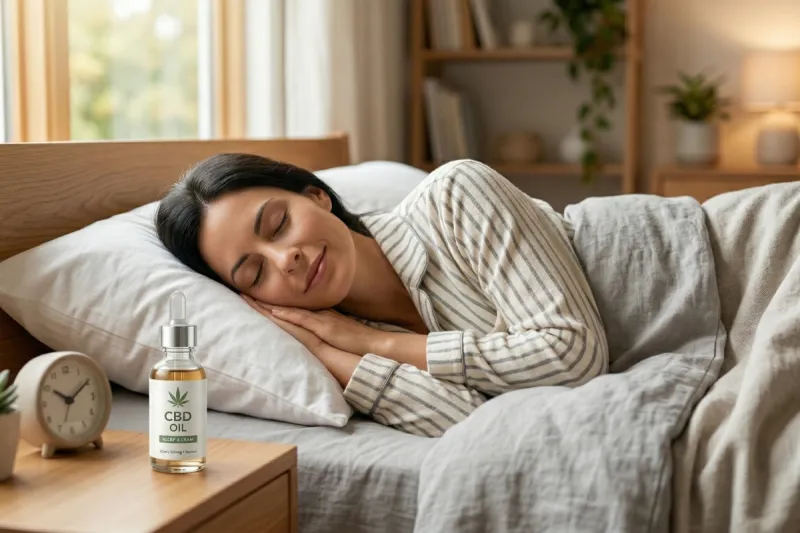
Photo: woman sleeping peacefully in bed with CBD oil tincture on nightstand, via salishtrails.co
It's 2 a.m. You've tried the lavender pillow spray. You've done the sleep meditation. You've powered down every screen in the house. And you're still staring at the ceiling, mentally replaying a conversation from 2019.
You're not alone. According to the CDC, roughly one in three American adults doesn't get enough sleep on a regular basis. And for millions of them, the usual fix — a prescription sleep aid — comes with a list of side effects that can feel worse than the insomnia itself. Grogginess, dependency, weird dreams, and that foggy "sleep hangover" the next morning have pushed a lot of people to start searching for alternatives.
Enter CBD oil.
Over the past few years, hemp-derived CBD has quietly become one of the most talked-about natural sleep aids in the country. But does it actually work? And how does it stack up against pharmaceutical options? Let's dig into what the research shows — and where the hype starts to outrun the evidence.
Why People Are Walking Away From Prescription Sleep Aids
Prescription sleep medications like zolpidem (Ambien) and eszopiclone (Lunesta) are effective for many people in the short term. No one's disputing that. But they come with real trade-offs.
Dependency is a major concern. Many prescription sleep aids are intended for short-term use, yet people often end up relying on them for months or years. There's also the issue of rebound insomnia — when you stop taking the medication, sleep can actually get worse before it gets better.
Then there are the side effects. Sleepwalking, memory issues, and next-day sedation are documented enough that the FDA has issued safety warnings about certain sleep medications. For a lot of Americans, especially older adults and people managing chronic health conditions, those risks feel like too high a price to pay for a decent night's rest.
CBD doesn't carry those same dependency concerns, and that's a big part of why people are curious about it.
What CBD Actually Does in Your Body at Night
Here's where it gets interesting — and where it's important to be honest about what we know versus what we're still figuring out.
CBD (cannabidiol) interacts with the body's endocannabinoid system (ECS), a network of receptors that plays a role in regulating mood, pain perception, immune response, and yes, sleep cycles. Rather than acting as a sedative the way a sleeping pill does, CBD appears to work more indirectly — addressing some of the underlying factors that keep people awake in the first place.
Anxiety is one of the biggest culprits behind poor sleep in America. A 2019 study published in The Permanente Journal found that 79 out of 103 patients reported lower anxiety scores after taking CBD, and nearly 67% reported improved sleep within the first month. That's a meaningful finding, even if the study was small.
CBD may also interact with receptors involved in regulating the sleep-wake cycle, including serotonin receptors, which influence mood and circadian rhythm. Some research suggests CBD could reduce the frequency of REM sleep behavior disorder — a condition where people physically act out their dreams — which is particularly relevant for people with PTSD or Parkinson's disease.
But let's be clear: the research is still early. Most studies are small, and the FDA has not approved CBD as a sleep aid. Anyone selling you CBD oil as a "guaranteed sleep cure" is overselling what the science currently supports.
The Dosing Question: How Much Should You Actually Take?
This is where a lot of first-timers get tripped up. CBD doesn't have a one-size-fits-all dosage, and the "right" amount for sleep can vary significantly from person to person depending on body weight, metabolism, the nature of your sleep issues, and the concentration of the product you're using.
That said, there are some general patterns worth knowing.
For sleep specifically, many users and practitioners report better results with moderate to higher doses — somewhere in the range of 25 to 75 mg taken about an hour before bed. Lower doses (under 15 mg) may actually be mildly stimulating for some people, which is counterproductive when you're trying to wind down.
The general guidance from most hemp wellness experts is to start low and go slow. Begin with a smaller dose for a week, track how you feel, and gradually increase until you find your sweet spot. Keeping a simple sleep journal during this period can be genuinely useful.
As for format, sublingual oils (drops held under the tongue for 60 to 90 seconds) tend to absorb faster than capsules or gummies, which have to pass through the digestive system first. If you want a more predictable onset time, tinctures are often the better choice for sleep.
Timing Is Everything
Taking CBD at the right time matters more than a lot of people realize. If you're using a sublingual oil, effects typically kick in within 15 to 45 minutes. Edibles and capsules can take 60 to 90 minutes or longer, depending on whether you've eaten recently.
A good rule of thumb: take your CBD dose 45 minutes to an hour before your intended bedtime. Pair it with other healthy sleep habits — keeping your bedroom cool, limiting caffeine after 2 p.m., and avoiding bright screens in the hour before bed — and you're giving yourself the best possible shot at a solid night.
What to Look for in a CBD Oil for Sleep
Not all CBD products are created equal, and this matters a lot when you're shopping for something to support your sleep.
First, look for full-spectrum or broad-spectrum CBD oil rather than CBD isolate. Full-spectrum products contain the full range of naturally occurring cannabinoids and terpenes from the hemp plant, including trace amounts of THC (under 0.3%, which is federally legal). This allows for what's called the "entourage effect" — the idea that these compounds work better together than in isolation. Certain terpenes, like linalool and myrcene, have their own calming properties that may contribute to better sleep.
Second, always check for a Certificate of Analysis (COA) from a third-party lab. This document confirms that the product contains what the label claims and that it's free from pesticides, heavy metals, and solvents. If a brand can't provide one easily, that's a red flag.
Finally, look for American-grown hemp. The U.S. has strict agricultural standards for hemp cultivation, and domestic sourcing generally means better quality control from seed to shelf.
The Bottom Line
CBD oil isn't a miracle insomnia cure, and anyone who tells you otherwise is selling something. But for people dealing with anxiety-driven sleeplessness, racing thoughts at bedtime, or the side-effect fatigue of pharmaceutical options, it's a genuinely promising natural alternative worth exploring.
The science is encouraging, the safety profile is favorable for most healthy adults, and the growing number of Americans turning to hemp-derived wellness products for sleep suggests that real experiences are backing up the early research.
Just go in with realistic expectations, buy from reputable sources, and give it a few weeks before you make up your mind. Your 2 a.m. ceiling-staring sessions might have met their match.